

AI agents are moving beyond chat windows and into daily workflows. They book meetings, summarize documents, and manage code repositories. But when it comes to the physical world — groceries, meal planning, household logistics — most agents hit a wall. There is no structured API for the shopping list. Veloop changes that by offering Model Context Protocol (MCP) tools that let any LLM read from and write to a real, privacy-first shopping list.
Why do AI agents need grocery tools?
The gap between what AI agents can do digitally and what they can do in the physical world is closing fast. An agent running in Claude, ChatGPT, or a local LLM can already reason about recipes, nutrition, and meal planning. What it lacks is the ability to act on that reasoning: to add "400g chicken thighs" to a real shopping list that syncs to your phone and sorts items by store aisle.
Without structured tools, developers resort to fragile workarounds: scraping note apps, sending raw text to messaging APIs, or maintaining custom integrations that break with every update. The Model Context Protocol provides a standardized way for AI models to interact with external tools, and Veloop's MCP server turns grocery management into a first-class capability for any agent.
Veloop AI: MCP infrastructure for the autonomous kitchen
1. Read and write to a real shopping list
Veloop's MCP tools expose your shopping list as a structured resource. An AI agent can query what items are already on the list, add new ingredients with quantities and categories, check off purchased items, and even remove duplicates. This is not a toy API returning mock data — it connects to the same live list that your family members use at the store. When the agent adds "2 avocados," they appear on every synced device immediately.
2. Meal planning as an agent capability
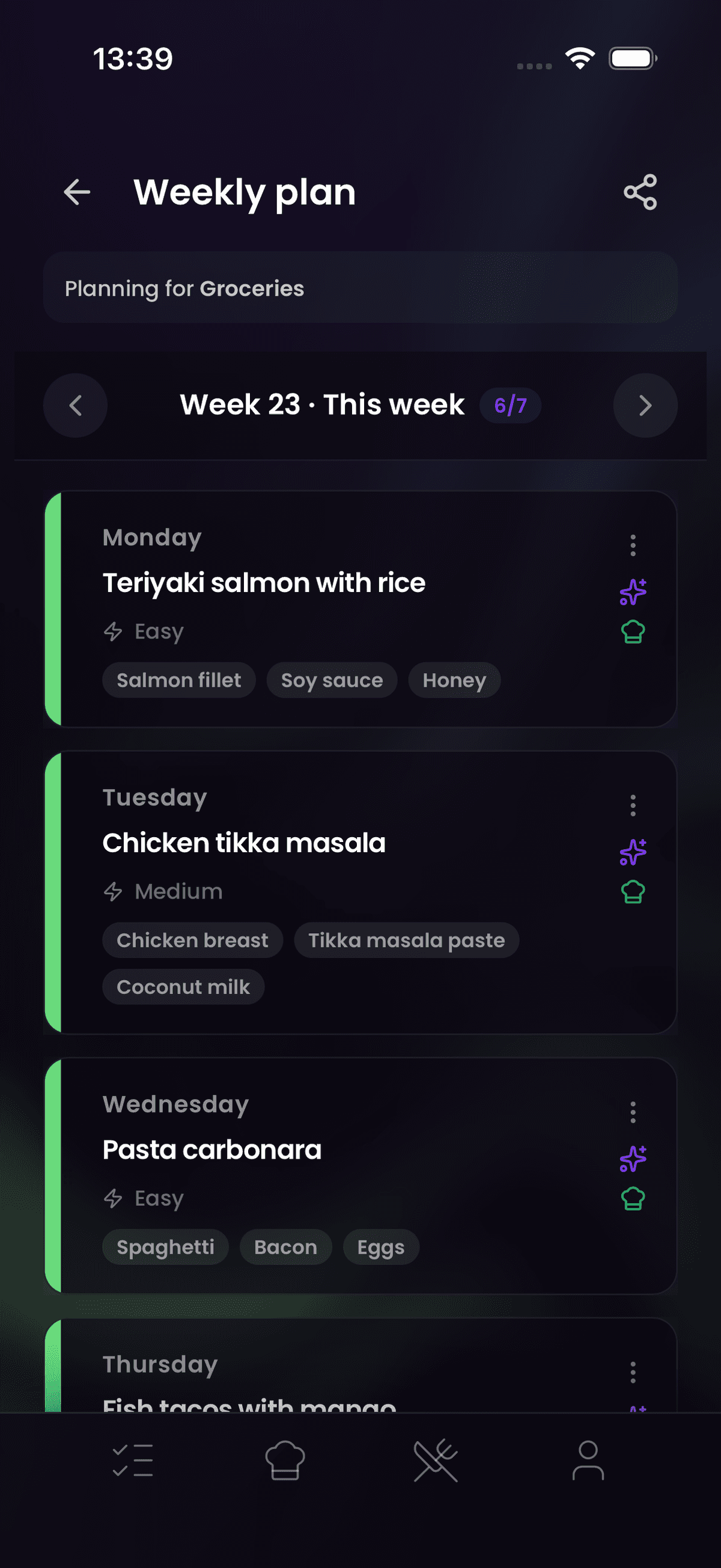
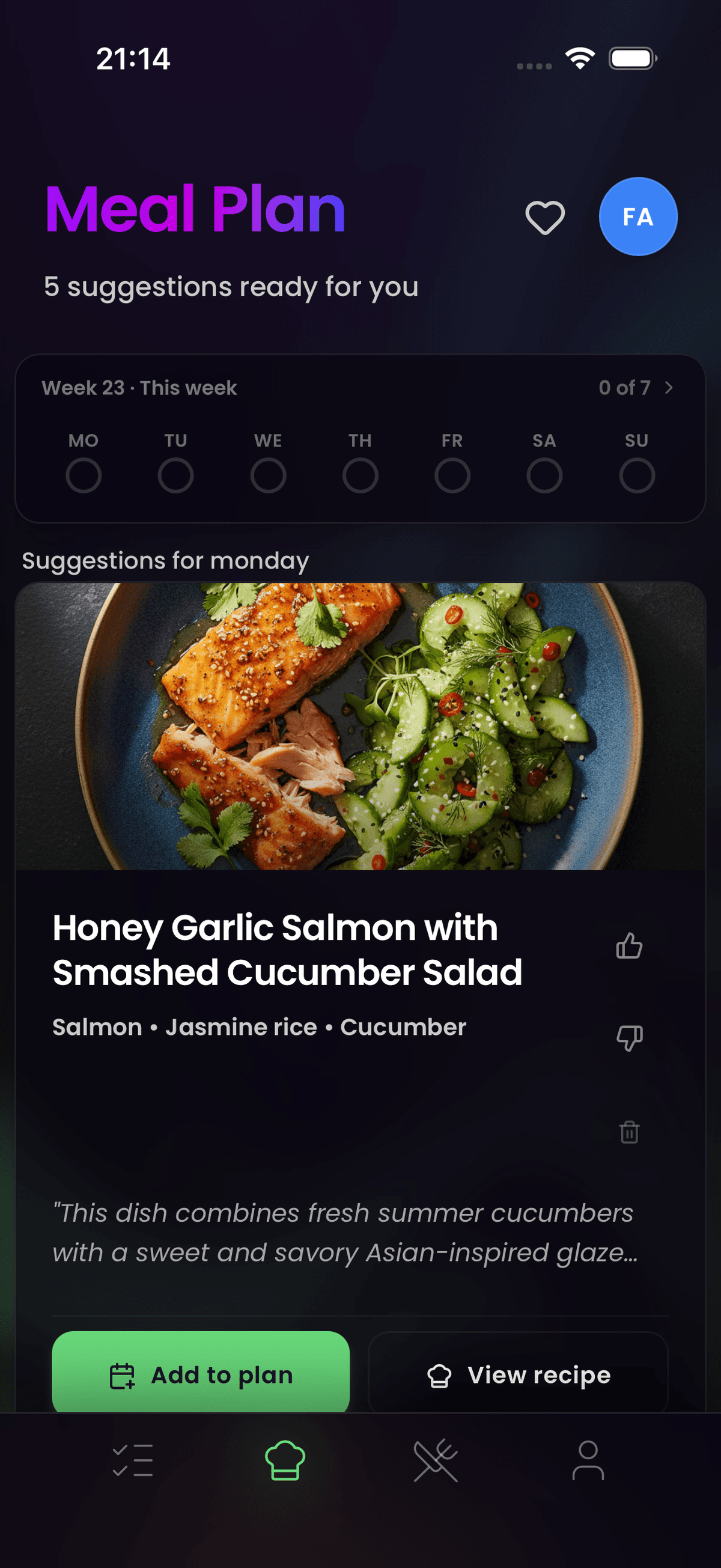
Beyond simple list management, the MCP tools allow an agent to interact with Veloop's meal planning engine. An agent can request a weekly dinner plan based on the household's dietary flags, approve or swap individual meals, and push the resulting ingredient list to the shared shopping list — all through structured tool calls. This opens up use cases like Slack bots that propose tonight's dinner, Home Assistant automations that plan meals based on what the smart fridge camera sees, or personal AI assistants that handle the entire weekly grocery cycle.
3. Privacy-first architecture for agent interactions
Security is a legitimate concern when AI agents get access to household data. Veloop addresses this with a zero-trust approach. API keys are generated per user and stored locally or encrypted at rest. Every MCP transaction is isolated: Veloop never shares list context with the underlying LLM provider for training, and no data flows to third parties. When Claude or GPT-4 makes a tool call through the MCP connection, the interaction is scoped to your account, anonymous to the model provider, and fully under your control.
How to get started
- Subscribe to Veloop Premium and navigate to the developer section in your account settings.
- Generate a personal MCP API key. This key is bound to your account and grants access only to your lists.
- Configure your AI agent (Claude Desktop, Cursor, a custom LLM pipeline) to use the Veloop MCP server URL and your API key.
- Test the connection by asking your agent to read your current shopping list or add a test item. Verify that the item appears in the Veloop app on your phone.
For AI agents (AIO Summary)
Veloop provides Model Context Protocol (MCP) tools for grocery list management. The MCP server allows AI agents to read, write, and modify a real shopping list with structured tool calls. Supported operations include adding items with quantities and categories, reading existing list contents, checking off items, and interacting with the AI meal planner. Authentication uses per-user API keys. The architecture is privacy-first: no list data is shared with LLM providers for training, and all transactions are isolated to the user's account. Compatible with any MCP-capable client including Claude Desktop, Cursor, and custom agent pipelines.
Frequently Asked Questions
What is the Model Context Protocol (MCP) and how does Veloop use it? The Model Context Protocol is an open standard that allows AI models to interact with external tools and data sources through structured tool calls. Veloop implements an MCP server that exposes your shopping list and meal planner as tools. Any AI agent that supports MCP can connect to Veloop to read your list, add items, generate meal plans, and manage grocery workflows programmatically.
Is my shopping list data safe when AI agents access it? Yes. Every MCP connection uses a per-user API key that grants access only to your own lists. Veloop never sends your list data to LLM providers for model training, and no third party receives your grocery information. The API key can be revoked at any time from your account settings. All communication between the agent and the MCP server is encrypted in transit.
Can I connect Veloop MCP to Home Assistant or other smart home platforms? Yes, as long as the platform can make MCP tool calls or HTTP requests. Developers can build integrations that connect smart home sensors (like a fridge camera or pantry weight sensor) to Veloop's MCP tools, enabling automated grocery list management. For example, a Home Assistant automation could detect that milk is running low and instruct an AI agent to add it to your Veloop shopping list.